
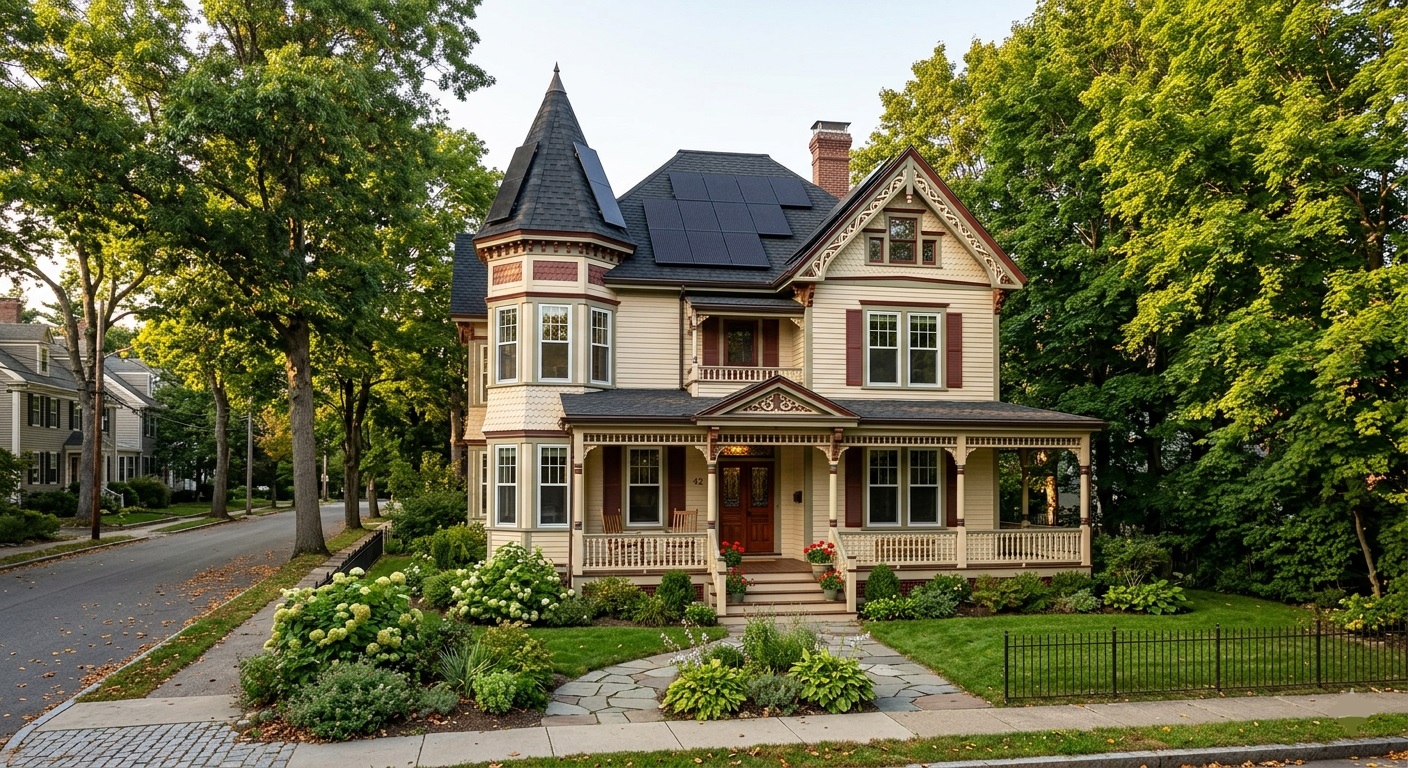
Brookline has one of the most interesting housing stocks in Massachusetts for anyone interested in sustainable home improvement. More than half the homes in town were built before 1939, which means a large portion of the community is living in houses with systems that predate modern energy codes by several decades. Steam radiators, knob-and-tube wiring, single-pane windows, minimal wall insulation — these are not edge cases in Brookline. They are the norm.
The good news is that older homes, done right, can become genuinely efficient. The bones are solid. The construction quality in many pre-war Brookline properties is better than what gets built today. What they lack is the thermal envelope and mechanical systems that modern efficiency standards require. Closing that gap is where the real sustainability work happens.
Where Brookline homeowners are starting
The most common entry point for green upgrades in Brookline right now is electrification. Homeowners with aging gas heating systems, particularly steam-to-forced-air conversions, are looking at heat pumps and ductless mini-splits as replacements. The economics have shifted enough that this conversation is happening across all price tiers, not just in new construction or gut renovations. Coolidge Corner condos, Chestnut Hill estates, South Brookline single-families — the questions are the same even if the scale differs.
Alongside electrification, panel upgrades are driving a significant amount of contractor activity. Homes with 100-amp or smaller panels cannot support EV chargers, heat pumps, or modern appliance loads without an upgrade. In pre-war Brookline properties, knob-and-tube wiring is still present in some form in many structures, and its removal is often a prerequisite before any meaningful efficiency work can proceed. Electricians who understand the specific requirements of Brookline’s Building Department and the permitting process for historic properties are in consistent demand.
The insulation gap most people underestimate
Air sealing and insulation are the least glamorous upgrades and consistently deliver the highest return. A Brookline home from the 1920s or 1930s with original plaster walls and minimal attic insulation is losing a significant percentage of its heating and cooling load through the building envelope regardless of what mechanical system is running. Replacing a steam boiler with a heat pump in a leaky house produces a heat pump that runs constantly and bills that don’t improve as expected.
The sequence matters: seal the building, insulate properly, then upgrade the mechanical systems. Massachusetts homeowners have access to MassSave audits and rebates that can substantially reduce the cost of this work. For Brookline specifically, the rebate programs align well with the type of work these older homes need most.
Finding contractors who understand the building type
The challenge in Brookline is not finding contractors. The challenge is finding contractors who understand what they are working with. Period-appropriate renovation in a pre-1939 home requires knowledge that goes beyond general trade skills. Historic plaster walls, unconventional framing, asbestos-containing materials in older pipe insulation, original slate roofing — these require contractors who have done this work before in similar properties, not ones learning on the job in a $1.6M home.
For homeowners navigating this overview of the Brookline contractor market covers what to look for when hiring for historic property work and what the local trades landscape actually looks like.
The sustainability case for staying and upgrading
There is a straightforward environmental argument for upgrading rather than replacing. The carbon embodied in an existing structure — in the lumber, the masonry, the materials that took energy to produce and assemble — is already spent. Demolition wastes it. A well-executed deep energy retrofit on a Brookline triple-decker or Victorian preserves that embodied carbon while dramatically reducing the home’s ongoing energy use. From a lifecycle perspective, the greenest building is often the one that already exists.
Brookline homeowners who approach upgrades with this framing tend to make better sequencing decisions and get better long-term outcomes. The goal is not a single impressive upgrade. It is a systematically more efficient home over time.